If you visited Pigeon Forge or Gatlinburg in the ’70s, ’80s, or ’90s, close your eyes for a second. Can you still smell the chlorine from Ogle’s wave pool mixed with Coppertone? Feel the rough concrete of the Water Boggan scraping your legs as you flew down that hillside? See that enormous plaster volcano rising up from the Parkway, promising adventures inside the “Center of the Earth”?
These places are gone now — replaced by mini-golf courses, dinner shows, and shopping centers. But the memories? Those are still here, tucked into the same mountain valleys where your parents first taught you to skip stones in the Little Pigeon River.
We went digging through old postcards, faded brochures, and boxes of vacation photos to bring back eight attractions that defined Smoky Mountain family vacations before Dollywood changed everything. Some of what we found might surprise you — like the fact that one of these places predicted smartphones 40 years early, or that another one is still partially standing if you know where to look.
So grab your own kids (or grandkids), settle in, and let’s take a trip back to the Parkway that was.
Magic World: Where Plaster Dinosaurs Met Animatronic Bears (1971–1996)

Remember when the biggest, most magical place in the universe was a hillbilly theme park with a 100-foot volcano for an entrance?
Magic World opened in 1971 on the Pigeon Forge Parkway, built by the Sidwell family — Big Jim, his wife Joyce, and their son. What started as a miniature golf course grew into something that one visitor called “an astounding hillbilly version of Disney’s Magic Kingdom.” And you know what? That’s exactly what made it perfect.
You walked through that rumbling volcano entrance — red lights flickering, recorded thunder echoing — past an 80-foot aquarium and suddenly you were standing in front of plaster dinosaurs, Arabian Nights castles, and a UFO theater all crammed together with absolutely no theme park logic whatsoever. There was a Dragon Train that chugged through “Dinosaur Valley.” A dark ride called “Land of Arabian Nights” that was basically Peter Pan if Peter Pan had been built in somebody’s garage. A Haunted Castle where Frankenstein and Dracula moved their heads back and forth like they were watching the world’s slowest tennis match.
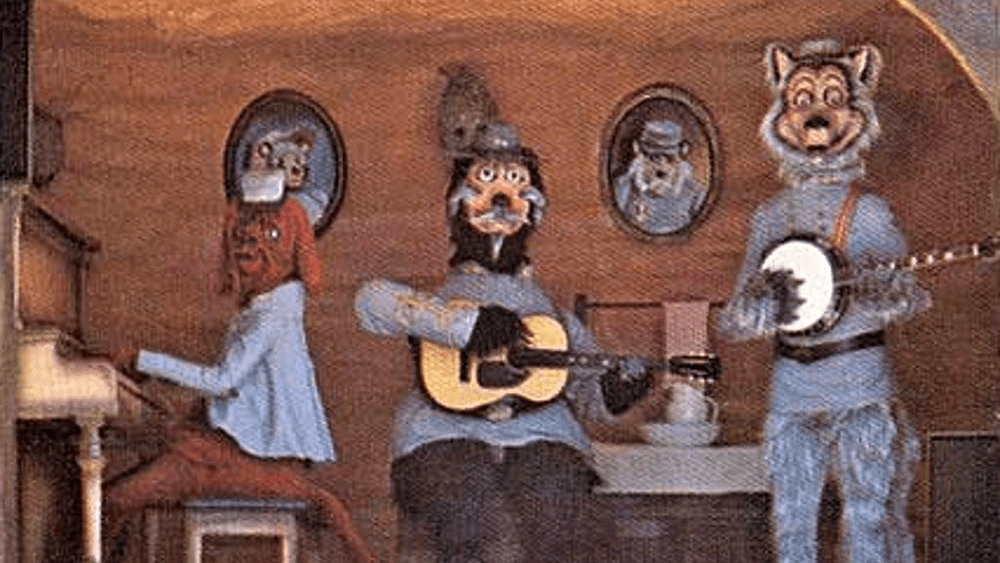
The park’s secret claim to fame? The Confederate Critter Show — three animatronic animals (a bear, a fox, and a hound dog) that performed inside a giant tree stump. Those characters were built by the same guy who created the Rock-afire Explosion at ShowBiz Pizza Place. Magic World wasn’t just weird — it was historically significant weird.
By the early ’90s, they’d added some carnival rides: a little steel coaster, bumper boats, a Tilt-A-Whirl. But the magic was always in the homemade stuff, the attractions that felt like your uncle built them in his backyard because he had a great idea and some leftover plaster.
What happened: Magic World didn’t fail. The business was fine. What happened was that Parkway land got too valuable. When the lease came up for renewal in 1995, the landowner decided to subdivide and sell rather than keep renting to a theme park. Just like that, the volcano went dark.
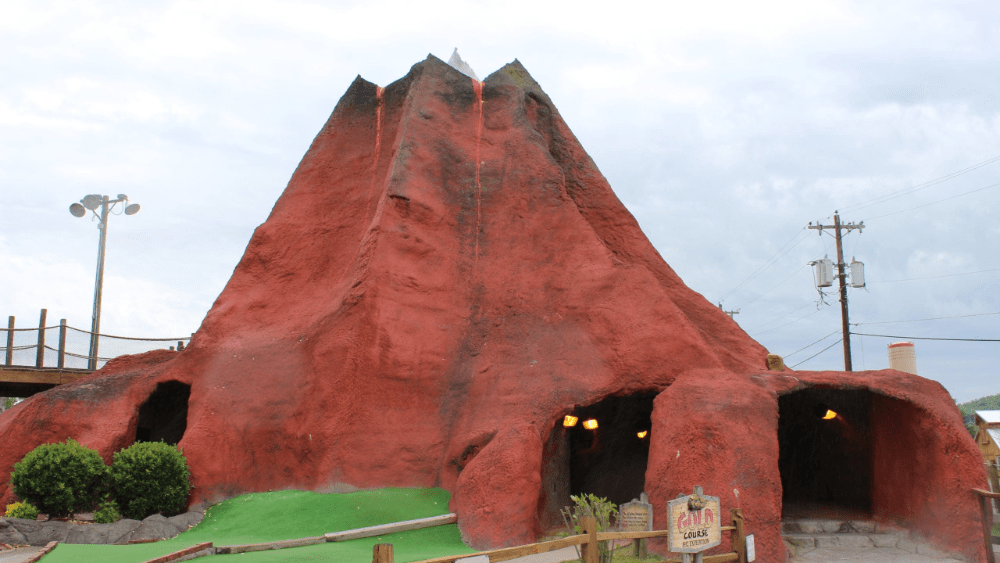
What’s there now: Here’s the good news — the volcano is still standing. Professor Hacker’s Lost Treasure Golf sits at 3010 Parkway, and if you look carefully, you’ll see that famous entrance incorporated right into the mini-golf course. There’s even a memorial plaque for Big Jim Sidwell. Your kids can putt a golf ball in the shadow of the same volcano you walked through 30 years ago.
What visitors remember: “I fondly remember school field trips to Magic World every year in elementary. Loved getting lost from the crowd and racking up some serious skee ball tickets. Didn’t cost much and was truly magical. 38 now and really appreciate the simple things.”
Ogle’s Water Park: Sunburns, Summer Romance, and That Wave Pool (1982–2002)
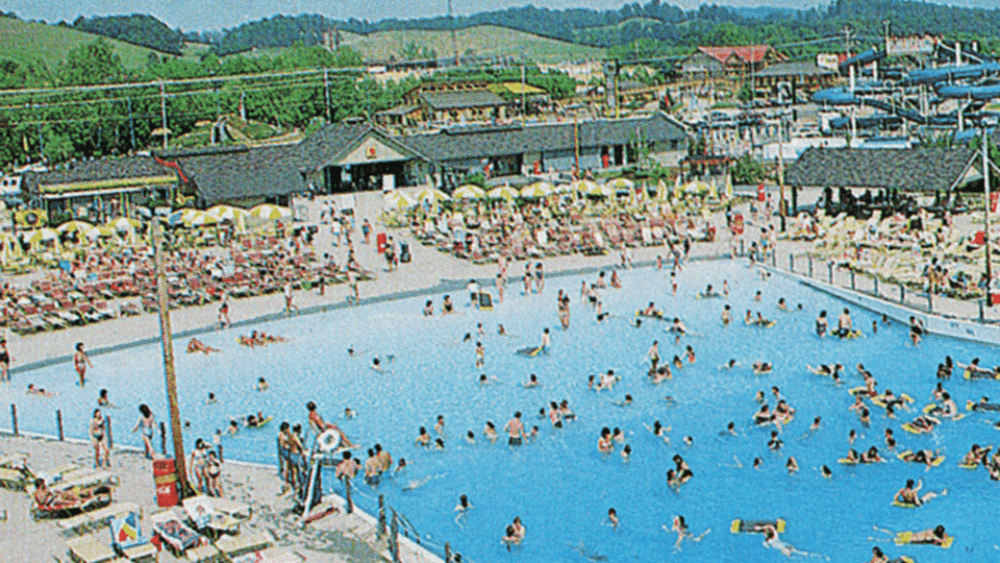
If you spent a summer day at Ogle’s in the ’80s or ’90s, you know exactly what we’re talking about.
It was the smell of sunscreen baking on hot asphalt. The feeling of watching cars creep by on the Parkway while you were standing in your swimsuit behind a chain-link fence, wondering if anybody you knew just drove past. The absolute chaos of that wave pool when the buzzer went off. The way your legs stuck to those plastic lounge chairs. The brain freeze from a too-cold sno-cone on a too-hot day.
Luther “Coot” Ogle — a descendant of Gatlinburg’s founding family — built the park at the corner of the Parkway and Wears Valley Road in the early ’80s. Six giant water slides with names like RipTide and Twin Twister. A wave pool that could hold what felt like half of Sevier County on a Saturday afternoon. A snack bar that sold exactly what you wanted: nachos, hot dogs, and freedom.

Was it fancy? Absolutely not. The whole place looked like it was built out of the same asphalt as the parking lot. But for kids whose parents dropped them off on the way to work, Ogle’s was heaven on earth. You could spend an entire day there for a few bucks, testing how many times you could ride the Hydro-Chute (the enclosed tunnel slide that felt like being shot through a storm drain) before you got dizzy.
What happened: Ogle’s closed after the 2002 season, and it wasn’t because Dollywood’s Splash Country killed the business. The Ogle family simply got an offer they couldn’t refuse. Prime Parkway real estate was worth more than a seasonal water park. They sold, retired, and the bulldozers showed up in 2003.
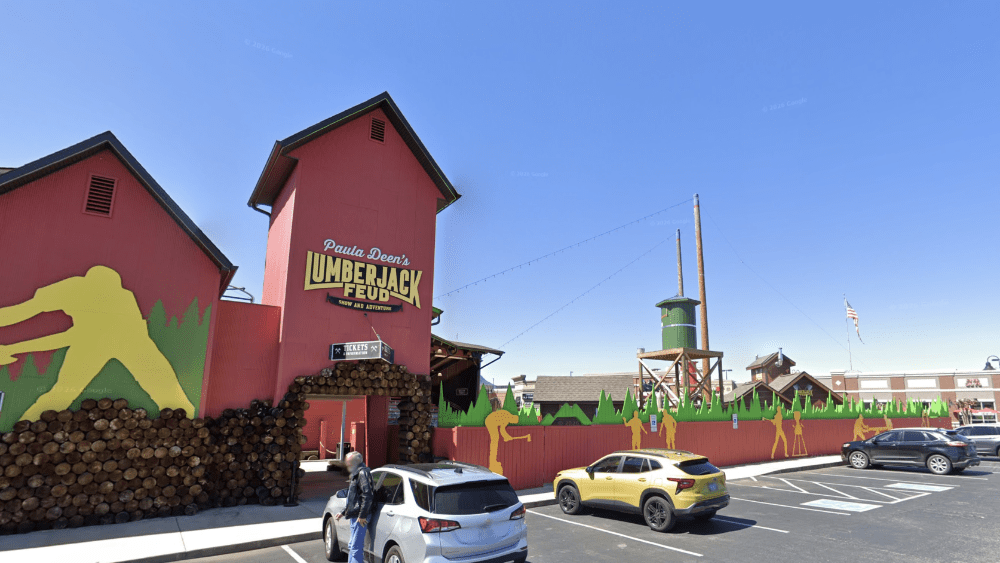
What’s there now: The site is now Lumberjack Square, home to Paula Deen’s Lumberjack Feud, the Forge Cinemas, and Smoky Mountain Brewery. Next time you’re grabbing a burger and a movie, you’re standing right where thousands of sunburned teenagers once tested the limits of how much chlorine the human body can absorb.
What visitors remember: “Ogle’s was sunbathing with the smell of Coppertone. It was testing the limits of how much heat you could take before dipping into the cooling, chemical waters. It was forgetting to reapply your sunscreen and paying the price the next day. It was also the birthplace of thousands of summer romances and more than a few heartbreaks.”
Xanadu House of the Future: Smart Home, 1982 Edition (1982–1986)
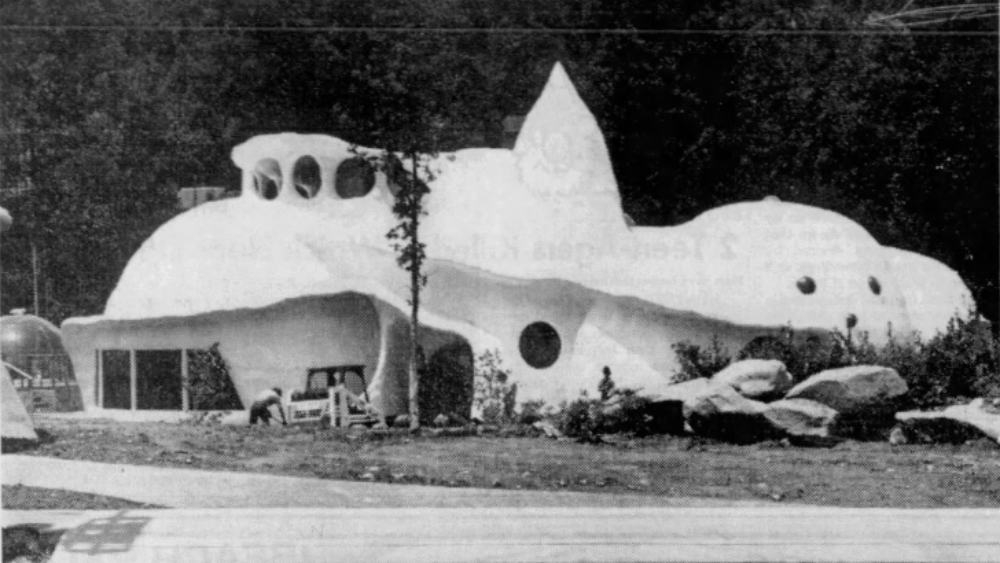
Imagine this: It’s 1982. You’re walking through downtown Gatlinburg and you see a cluster of white alien domes rising up near the tram. A sign promises to show you the “House of the Future.”
You walk inside and suddenly you’re standing in a 7,600-square-foot smart home that has electronic mail, a computer that plans and cooks your meals automatically, tele-shopping for groceries, a sensory isolation tank, and an induction stove that doesn’t even exist in American kitchens yet. Oh, and the kids’ bedroom has an indoor slide that drops you directly into bed.
This was Xanadu — one of three “houses of the future” built nationally using the same bonkers construction method: spray polyurethane foam over giant inflated balloons, wait for it to harden, then pop the balloons and carve out windows and doors. The result looked like something the Jetsons would build if the Jetsons were really into foam insulation.
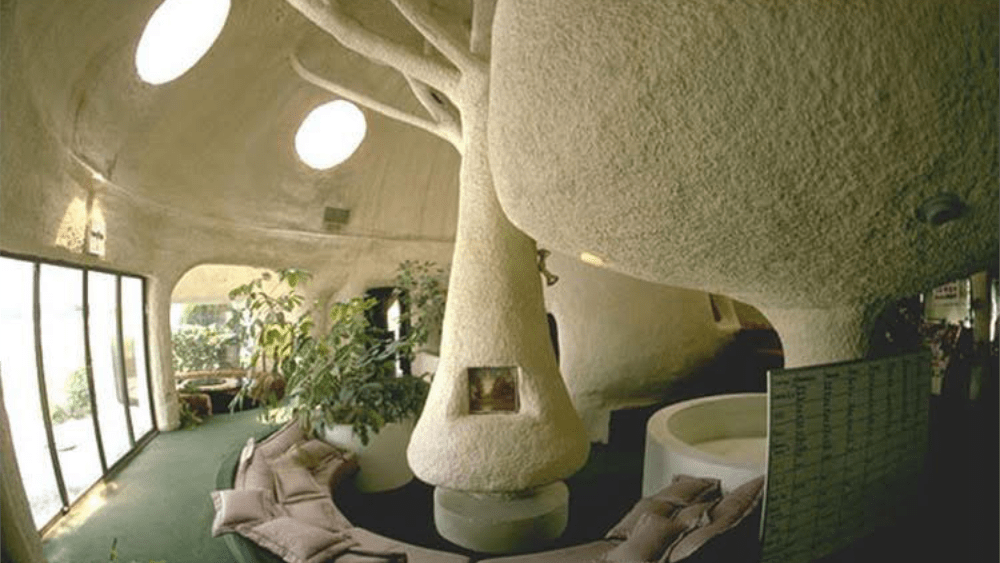
Xanadu opened in June 1982 — timed perfectly to capitalize on the World’s Fair in Knoxville that same year. The technology inside was legitimately decades ahead of its time. That Commodore microcomputer controlling the lights, temperature, and security? That was home automation before most people had heard the term. The Autochef planning balanced meals? That’s basically a 1982 version of a smart kitchen assistant.
What happened: Locals hated it. Less than a month after opening, a petition was presented to the Gatlinburg City Commission calling Xanadu “a blight upon our fair city.” People called it “that thing on the Parkway.” By 1986, the novelty had worn off — the house of the future had become the house of the present, as its once-revolutionary technology started showing up in regular stores. It closed that summer and was demolished in the early ’90s.
What’s there now: A parking lot. The site went from Xanadu to mini-golf to a wedding chapel to its current incarnation as asphalt. Sometimes the future doesn’t stick around.
What visitors remember: “I loved Xanadu, the house of the future. I dreamed of having a house just like it when I grew up. Loved that it had a slide by the stairs for kids to use and a sunken dining room table and just whimsical shapes inside and out!”
Water Boggan: Pain, Terror, and the Best Day Ever (Mid-’70s–Late ’80s)
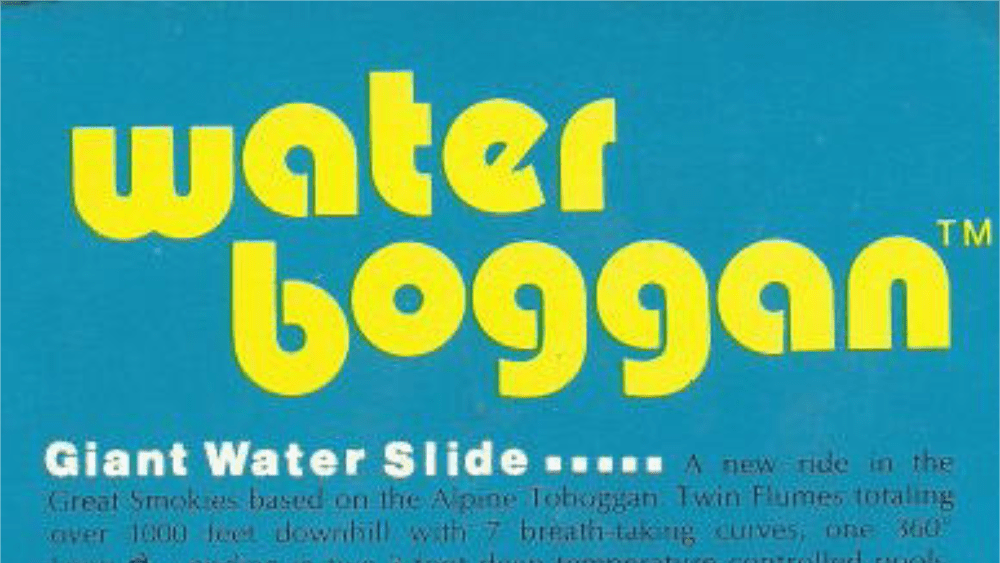
Let’s be honest: the Water Boggan was a lawsuit waiting to happen.
Concrete flumes carved into a natural hillside at the far north end of the Parkway. Over 1,000 feet of textured, painted concrete with seven turns and a full 360-degree loop. You were handed a foam rubber mat, told to sit on it, and sent careening down feet-first into a three-foot splash pool.
If you lost your mat halfway down — which happened constantly — you got road rash. If you tried to walk back up those concrete stairs barefoot in July, you got blisters. If you made it through a full day without some part of your body turning red and raw, you were either very lucky or very careful, and careful kids didn’t ride the Water Boggan.
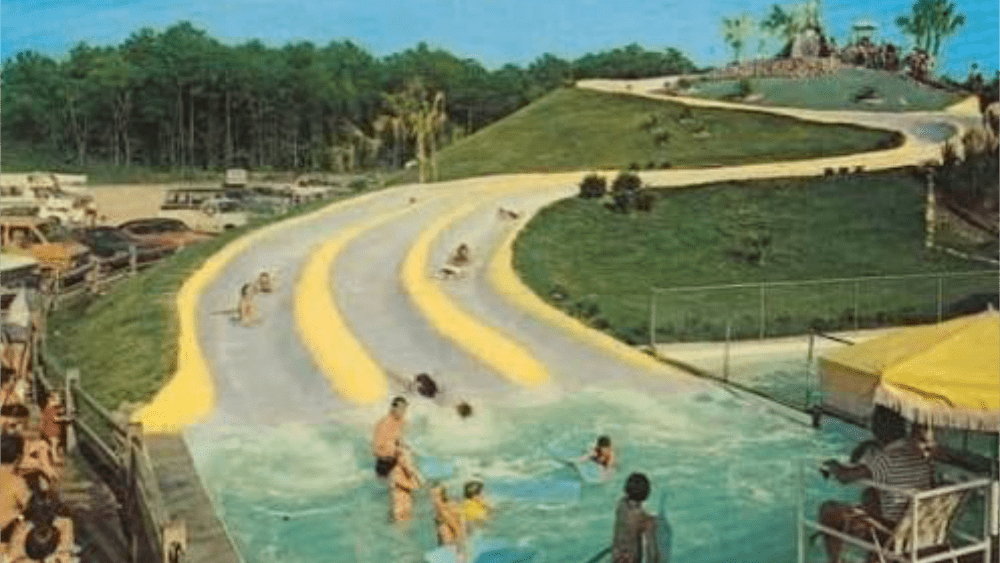
And yet. And yet. Ask anyone who went there about their favorite childhood memories in the Smokies, and the Water Boggan comes up immediately. Because sure, it hurt like hell, but you also spent the entire day racing your siblings, perfecting your technique, and feeling absolutely, gloriously free.
This was the era when the water park industry thought concrete was a perfectly acceptable surface for nearly-nude people to slide down at high speed. The Water Boggan was part of a regional chain invented by a guy from North Carolina who got a patent for “amusement water slides” in 1975. Locations popped up all over the Southeast. They were all the same: hillside, concrete, pain, glory.
What happened: Ogle’s Water Park opened with smooth fiberglass slides and a wave pool. Suddenly, paying to scrape your skin off on concrete seemed less appealing. Liability concerns grew. The Water Boggan quietly closed in the late ’80s.
What’s there now: The hillside is dotted with rental cabins. If you know which ones to book, you’re literally sleeping on the same ground where you once tested your pain tolerance.
What visitors remember: “I remember riding this water slide with my brother all day long. We were about 7 and 8 years old in the 70s. Our little butts and legs were tore up. There was so much freedom. My brother recently died at the age of 54. This is one of the best memories I’ve had of my childhood with him.”
Louise Mandrell Theater: When Country Came to the Parkway (1997–2005)
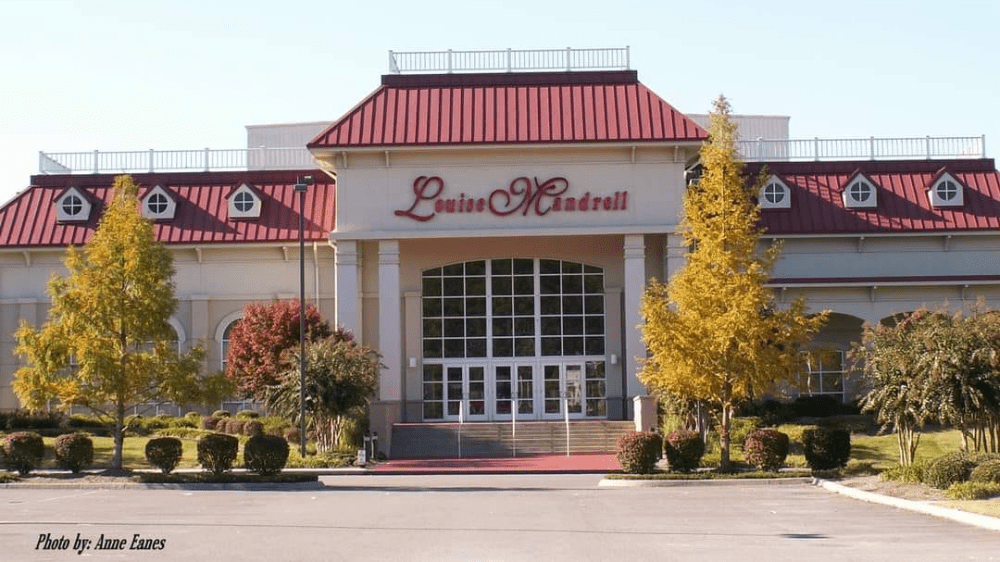
Before Pigeon Forge became dinner-show central, there was a different kind of entertainment revolution happening on the Parkway. In the late ’90s and early 2000s, country music stars tried to do something ambitious: set up Vegas-style residencies in the Smokies. Louise Mandrell — younger sister of Barbara Mandrell and a successful country artist in her own right — decided to plant roots.
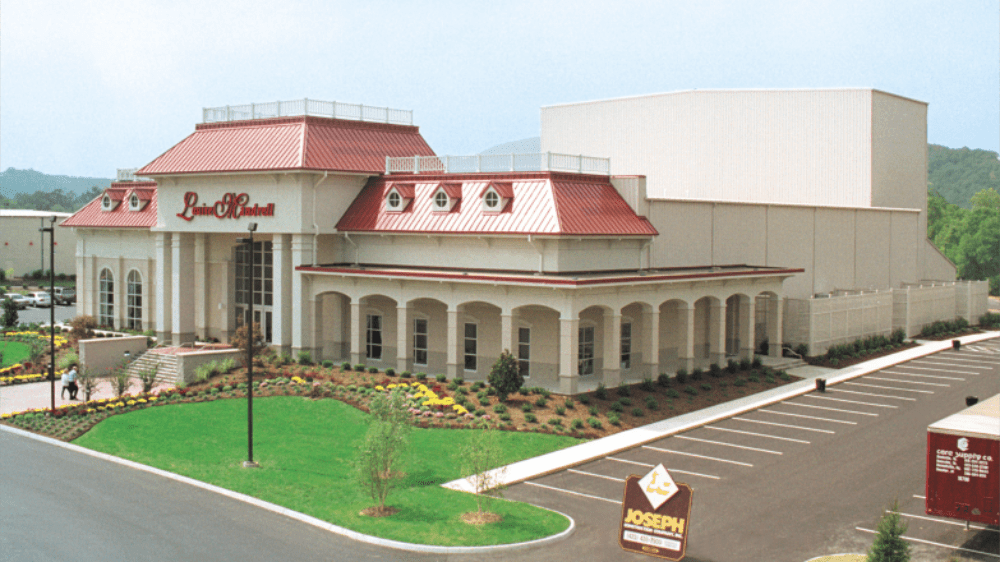
On September 12, 1997, the Louise Mandrell Theater opened its doors at 2046 Parkway with 1,400 seats and a promise: Louise would be there for every single show. Not a rotating cast of performers. Not a “when she’s available” schedule. Every. Single. Performance.
And she meant it. For eight years, Louise Mandrell showed up six nights a week to put on a two-hour extravaganza that felt like Vegas met the Grand Ole Opry met Broadway. The production had it all: elaborate costumes shipped in from New York, lavish sets designed by one of the country’s top theatrical designers, a full live orchestra, 15-foot puppets, special effects, and a finale with confetti and balloons raining down on the audience.
But what really made the show special was Louise herself. She was a one-woman band — literally. In a single performance, she’d play fiddle, drums, bass, accordion, and at least half a dozen other instruments. She’d sing everything from country and jazz to big band and gospel. She’d dance. And she’d make it all look effortless, like she was just having friends over for the night’s best party.
The theater quickly became “the most attended show in Pigeon Forge” — no small feat in a town where entertainment venues were popping up left and right. Families came back year after year. Louise became part of the community, raising money for the United Way, the American Cancer Society, and Boy Scouts of America through her Celebrity Shoot television specials.
What happened: In 2005, Louise made the same decision she’d made in 1997, just in reverse. She’d opened the theater to spend more time with family while still performing. Eight years later, she closed it for the same reason — to move back to Nashville and be closer to her husband. Her final show on New Year’s Eve 2005 was a sold-out house.
The Fee Hedrick Family Entertainment Group bought the theater and poured $15 million into renovations, reopening it in 2006 as “The Miracle Theater” — a Christian-themed production about the life of Jesus, complete with live animals, sword fights, and angels on wires. That show ran until 2011. The building became the Smoky Mountain Opry in 2011, then closed for good in May 2020 during the pandemic and never reopened.
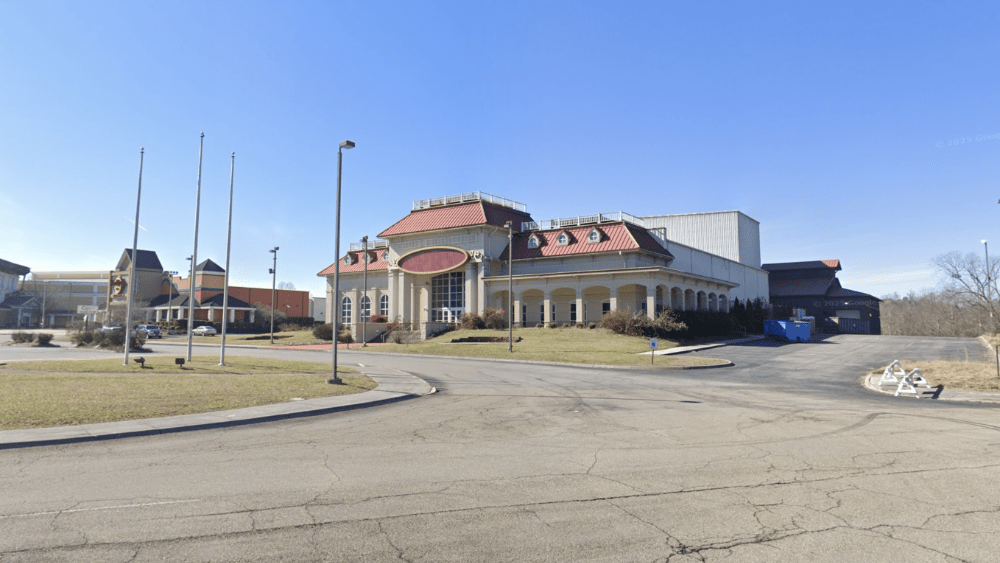
What’s there now: As of 2026, the building sits waiting. The Crayola Experience and NERF Action Xperience were announced for the site in 2023 with an expected fall 2024 opening, but construction has been delayed. For now, the 1,400-seat theater where Louise Mandrell played fiddle and lit up the Parkway six nights a week sits dark at 2046 Parkway — still recognizable, still waiting for its next chapter.
What visitors remember: One TripAdvisor review from 2006: “The last time we were in Pigeon Forge, my wife and I both enjoyed this show and thought it was without a doubt the best in the area.”
Three More Lost Pieces of the Old Parkway
Porpoise Island (1972–1984)

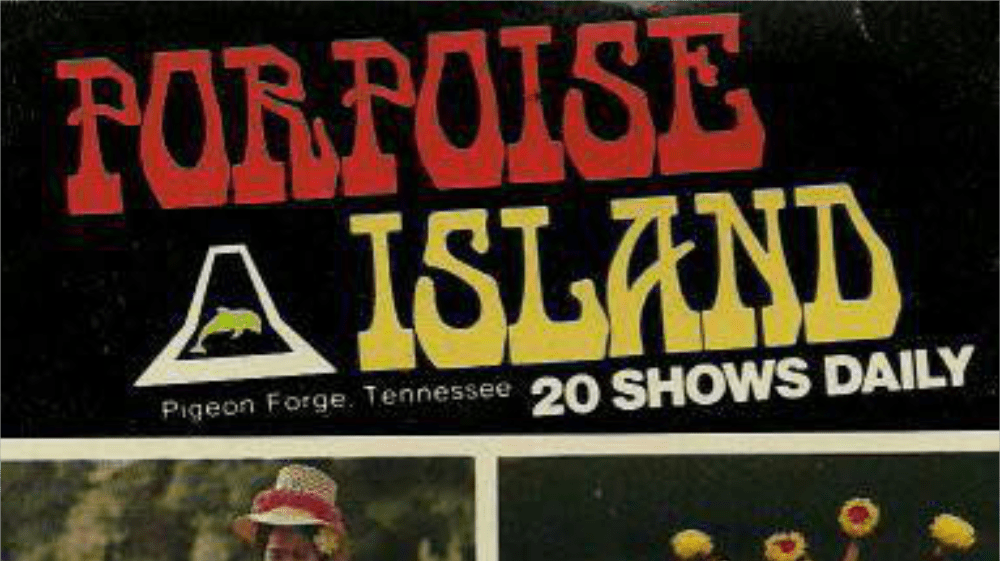
A Hawaiian-themed marine park on an island in the Little Pigeon River where dolphins did tricks, sea lions performed in a “Bird Vaudeville Theatre,” and actual hula dancers from Hawaii performed luaus every night. The dolphins were trucked in from Mississippi every season. The whole operation was gloriously, impossibly expensive. The site is now The Island in Pigeon Forge — same river, completely different vibe.

Fun Mountain (1993–2000)

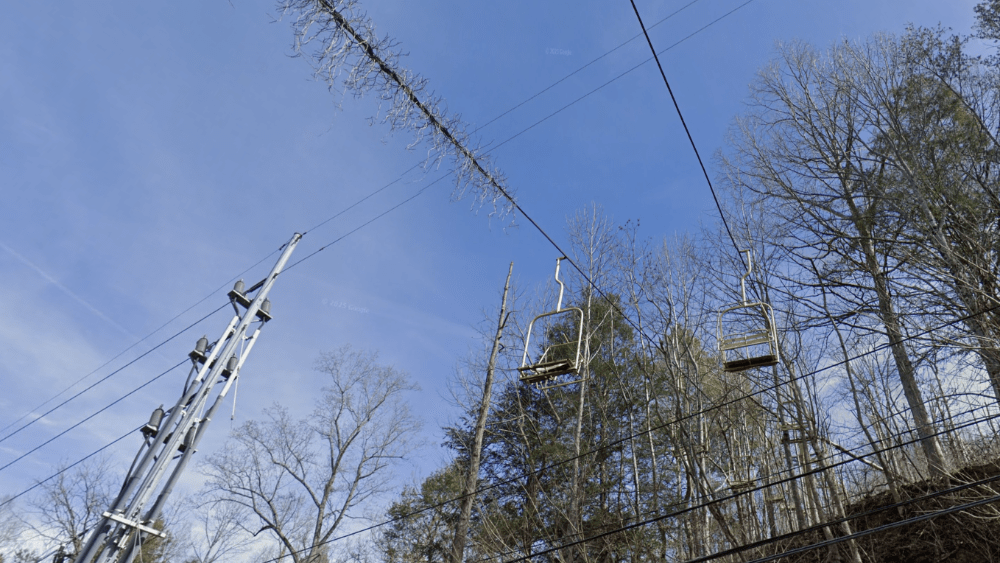
An entire amusement park that lasted just seven years at the entrance to Gatlinburg. Go-karts, bumper cars, a Ferris wheel, Gatlinburg’s longest chairlift, and a beautiful antique carousel — all gone by 2000. The site sits abandoned, and you can still see rusted remnants of the old chairlift from the parking lot if you know where to look.
Smoky Mountain Car Museum (1956–c. 2012)
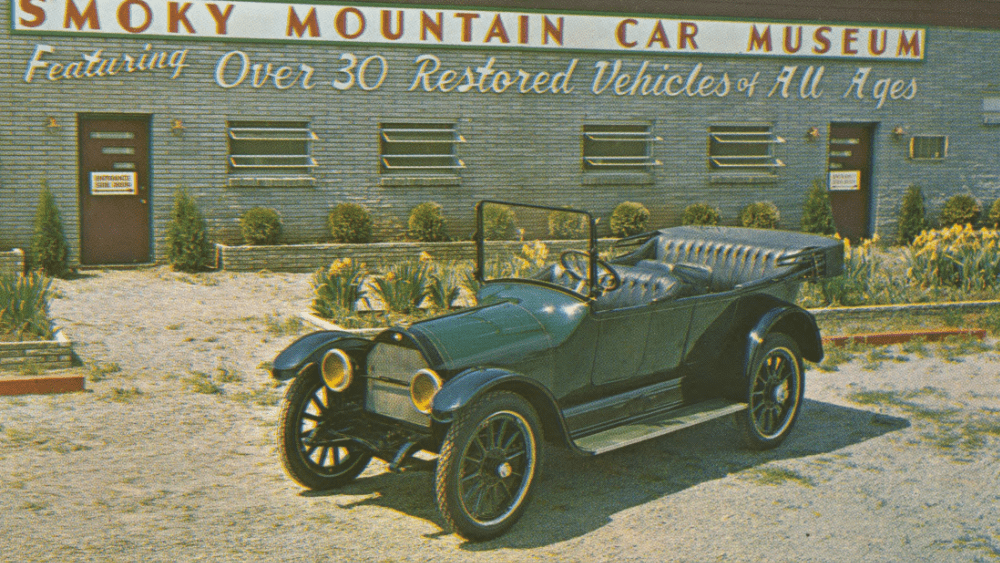
For over 50 years, this family-run museum displayed Elvis’s Mercedes, James Bond’s Aston Martin with working machine guns, Al Capone’s bulletproof Cadillac, and Hank Williams Jr.’s Silver Dollar Cadillac decorated with 547 actual silver dollars. The spot is now a Dollar General.
Why They’re Gone (And Why That’s Actually Okay)
The Parkway you remember from childhood is gone because the Smokies got too popular for their own good.
Dollywood’s opening in 1986 was the tipping point. Suddenly, the scrappy family-run attractions couldn’t compete with corporate-scale entertainment. Land values shot through the roof. One by one, local families who’d operated these places for decades faced the same math: the dirt under their attraction was worth more than the attraction itself.
Magic World lost its lease. The Ogle family sold. Xanadu was razed. The Water Boggan hillside was subdivided. Porpoise Island became a shopping complex.

But here’s the thing — and this is important to remember as you’re planning your own family’s Smokies trip: the attractions changed, but the experience didn’t.
Your kids won’t walk through a plaster volcano to go see some animatronic confederates, but they’ll walk through plenty of wonderfully weird roadside attractions that make absolutely no logical sense. They won’t ride the Water Boggan, but they’ll come back from Dollywood’s Splash Country with their own stories of the slide that scared them half to death and the wave pool where they laughed so hard they swallowed water.
They won’t experience Magic World the way you did. But when they’re 40, standing in some future version of the Smokies explaining to their kids what The Island used to be, they’ll understand exactly how you feel right now.
Come Make New Memories in the Same Mountains
The Smokies have always been about families making memories in imperfect, wonderful places. The attractions change — volcano theme parks become mini-golf courses, water slides become dinner shows — but the mountains stay the same. The rivers still flow. The fireflies still light up the summer nights. And families still pile into cars and head up 441 with that same feeling of anticipation you remember from childhood.
At Hapey Cabin Rentals, we’ve been helping families create Smoky Mountain memories for nearly a decade. Our six pet-friendly cabins in Pigeon Forge, Gatlinburg, and Sevierville give you the perfect home base to explore both the new Parkway and the old places that are still hiding in plain sight.
Because here’s what we’ve learned: it doesn’t matter if your kids are riding the Dragon Coaster at Magic World or the Tennessee Tornado at Dollywood. What matters is that 30 years from now, they’ll close their eyes and be able to smell that mountain air, feel that excitement, and remember the vacation when Dad got hopelessly lost trying to find the cabin and Mom made everyone stop for ice cream anyway and it turned into the best day of the whole trip.
The Smokies are still here. The memories are waiting to be made. We’d love to help you create the next chapter.
Ready to book your family’s next Smoky Mountain adventure? Browse our pet-friendly cabins — because your furry family members deserve to make memories too. All of our properties feature hot tubs (the adult version of that wave pool you remember), arcade games for rainy afternoons, and most have fenced yards so your pup can explore safely.
Book direct and skip the platform fees. Your next family story starts here.