You’ve been planning this trip for weeks. You’ve packed the hiking boots, the snacks, the camera. You’ve even found a pet-friendly cabin in Pigeon Forge. Your dog — let’s call her “Scout” — is practically vibrating in the back seat as you pull into the Great Smoky Mountains National Park.
Then you see the sign.
“Pets not permitted on trails.”
Cue the collective groan from every dog parent who’s been here before.

Here’s the truth that nobody tells you before you book: Great Smoky Mountains National Park has some of the strictest pet restrictions of any major national park in the country. Dogs are banned from almost all of the park’s 800+ miles of trails. If you’re coming to the Smokies with your four-legged family member, you need to know the rules before you arrive — not after you’re already standing at the trailhead.
The good news? The Smokies is still an incredible destination for dogs and the people who love them. You just need to know where to go, what the rules actually are, and how to plan a trip your whole family (fur babies included) will remember forever.
This guide covers everything: what the GSMNP policies actually say, the two trails where dogs are allowed in the park, and a full menu of fantastic pet-friendly alternatives within easy driving distance of your cabin.
Why Does GSMNP Restrict Dogs on Trails?
Before anything else, it’s worth understanding why Great Smoky Mountains National Park maintains such strict pet policies. The park isn’t being arbitrary or anti-dog. The restrictions exist for a few specific, well-documented reasons.
Wildlife protection. GSMNP is home to roughly 65 species of mammals, including black bears, white-tailed deer, wild turkeys, and dozens of smaller critters. Dogs — even calm, well-trained ones — carry the scent of a predator. That scent alone can disrupt nesting birds, stress out small mammals, and send wildlife fleeing from areas they need to feed and rest. The park’s wildlife managers have seen firsthand how even a single dog on a trail can clear out an entire stretch of natural habitat.
image: smokies-salamander-preservation.jpg

Salamander and amphibian preservation. Here’s one most visitors don’t expect: the Smokies is considered the salamander capital of the world. There are over 30 species of salamanders here, many of them found nowhere else on earth. Dogs walking along streams and through wet areas — the exact terrain that makes up so many Smokies trails — can spread diseases that devastate salamander populations. Chytrid fungus, carried on paws and wet fur, has already decimated amphibian species globally. The park takes this seriously.
Trail ecology. Dog waste, even when bagged and removed, changes the microbiology of trail ecosystems. Urine markings introduce foreign hormones and chemicals into environments that took thousands of years to develop. In a park that sees 12+ million visitors per year, those small impacts multiply fast.
Other visitors’ experience. Many people come to GSMNP seeking quiet and wildlife encounters. An excited dog barking at a black bear in a crowded area creates a safety problem — both for the dog and the bear.
None of this means your dog is bad. It means the ecosystem is fragile and precious, and the park is making a call that protects it for everyone’s future.
The Official GSMNP Pet Policy: What You Need to Know
Here’s a plain-English breakdown of the current National Park Service rules for pets in Great Smoky Mountains National Park.
Where pets ARE allowed:
- Campgrounds (in developed areas, not backcountry)
- Picnic areas
- Paved roads and parking areas
- The Gatlinburg Trail
- The Oconaluftee River Trail
Where pets are NOT allowed:
- All other hiking trails (that’s 800+ miles of them)
- Backcountry campsites
- Any park building or visitor center
- Ranger programs or outdoor amphitheaters
Leash rules: When your pet is in any permitted area, they must be on a physical leash no longer than 6 feet. Voice control doesn’t count. Retractable leashes that extend beyond 6 feet are technically non-compliant. Enforcement does happen — rangers can and do issue fines.
Why this matters more than you think: A lot of visitors assume that if they’re in a parking area or along the road, they can let their dog off-leash “just for a minute.” Those quick off-leash moments are exactly how dog-wildlife encounters happen, and in bear country, that’s a situation nobody wants.
The Two Trails Where Dogs ARE Allowed in GSMNP
There are exactly two trails inside Great Smoky Mountains National Park where you can bring your leashed dog. Know them well — they’re genuinely wonderful walks, and they give you and Scout a legitimate GSMNP experience.
1. The Gatlinburg Trail
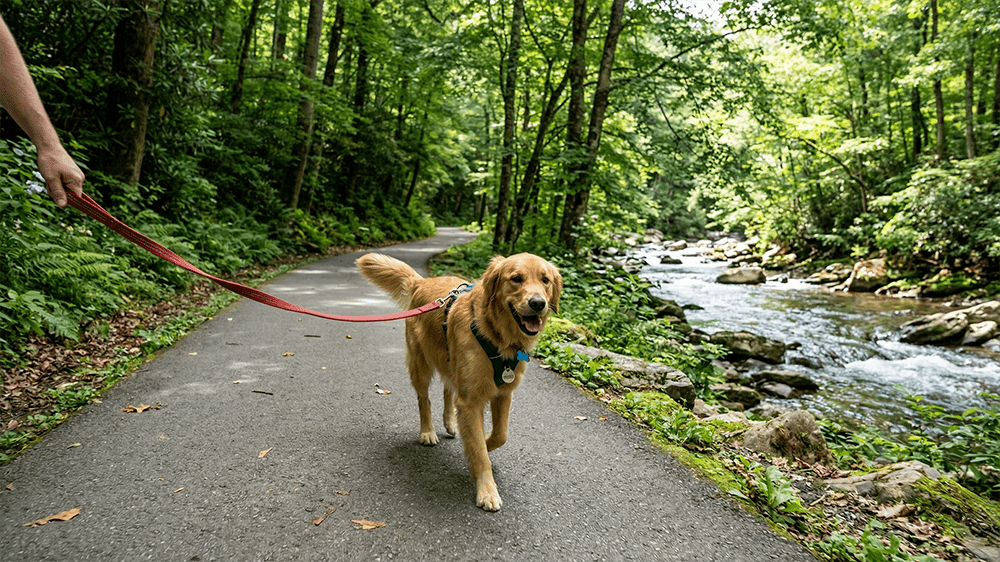
Distance: 1.9 miles one-way (3.8 miles round trip)
Difficulty: Easy
Elevation gain: Minimal
Terrain: Mostly flat, riverside path
Starting point: Sugarlands Visitor Center, just outside Gatlinburg
The Gatlinburg Trail runs from Sugarlands Visitor Center along the West Prong of the Little Pigeon River toward the edge of downtown Gatlinburg. It’s flat, scenic, and shaded — a genuinely lovely walk that follows the river through lush forest.
Because it’s easy and accessible, it can get busy on weekends and during peak seasons. Go early in the morning (think 7–8 AM) to beat the crowds and give your dog the best experience. The river crossings and rocky banks make for natural rest stops where Scout can splash around and cool off.
Pro tip: Park at the Sugarlands Visitor Center, walk the trail toward Gatlinburg, then turn around and retrace your steps. There’s no loop, so round-trip planning is key.
Dog-friendliness rating: ⭐⭐⭐⭐ — Flat, shaded, riverside. A genuine winner for dogs of all ages and fitness levels.
2. The Oconaluftee River Trail
Distance: 1.5 miles one-way (3 miles round trip)
Difficulty: Easy
Elevation gain: Minimal
Terrain: Flat, riverside path
Starting point: Oconaluftee Visitor Center, near Cherokee, NC
On the North Carolina side of the park, the Oconaluftee River Trail follows the Oconaluftee River from the visitor center toward the Mountain Farm Museum. Like the Gatlinburg Trail, it’s flat, river-hugging, and genuinely beautiful. The Mountain Farm Museum at the far end is one of the most charming spots in the entire Smokies region — a preserved collection of original 19th-century mountain buildings that you can walk through (though dogs aren’t allowed inside the buildings themselves).
Pro tip: This trail connects to the town of Cherokee at the far end, which means you can make a morning of it — walk the trail, then explore Cherokee’s shops and restaurants with your dog.
Dog-friendliness rating: ⭐⭐⭐⭐ — Quieter than the Gatlinburg Trail, especially on weekdays. A peaceful riverside walk with some of the most scenic views in the park.
What to Do Instead: The Best Dog-Friendly Hiking Near the Smokies
This is where the story gets good. Because while GSMNP has strict restrictions, the land surrounding the park — particularly Cherokee National Forest and the broader mountain corridor — offers hundreds of miles of dog-friendly trails. Some of them are as spectacular as anything inside the national park.
Cherokee National Forest: Your Dog’s Backcountry Playground
Cherokee National Forest wraps around GSMNP to the north and south, and here the rules are dramatically different. Dogs are allowed on virtually all trails in the national forest, as long as they’re leashed where required and cleaned up after. This opens up a massive range of options.

Fiery Gizzard Trail (South Cherokee National Forest) One of Tennessee’s most celebrated hiking trails, the Fiery Gizzard runs through dramatic sandstone gorges with waterfalls, rock formations, and jaw-dropping canyon views. At about 15 miles for the full trail (or shorter out-and-back segments), it’s best suited for athletic dogs and their owners. The terrain is rugged and beautiful.
Coker Creek Falls A moderate 2-mile round trip through hardwood forest to a stunning 30-foot waterfall. Dogs love the creek crossings along the way, and the falls are dramatic enough to justify the drive. Located in the Tellico Ranger District.
Bald River Falls This one is almost unfair in its beauty. The 30-foot Bald River Falls is just a short walk from the parking area, and dogs are welcome. The trailhead sits right on a scenic byway, so you can pair it with a slow drive through forest roads with the windows down.
Tellico River Recreation Area Miles of riverside trails along the Tellico River, with multiple access points. The water is clean and cold — perfect for swimming dogs. Scattered campsites mean you can make a full day of it.
Nantahala National Forest (NC Side)
South of Cherokee on the North Carolina side, Nantahala National Forest offers another enormous stretch of dog-friendly backcountry. The Joyce Kilmer Memorial Forest — a rare old-growth forest with trees over 400 years old — has dog-friendly trails that feel genuinely primeval. Walking through 100-foot tulip poplars with your dog is an experience you won’t forget.
Local Greenways and Town Trails
Don’t overlook the excellent paved trails and greenways in the towns themselves. These are lower-key than backcountry hiking but perfect for daily walks and easy exploration.
Riverwalk Trail, Pigeon Forge: A paved greenway running alongside the Little Pigeon River through the heart of Pigeon Forge. Dogs are welcome. It’s flat, wide, and gives you access to multiple shopping areas — great for a leisurely morning walk with coffee in hand.
Douglas Lake Access: About 20 minutes from Sevierville, Douglas Lake offers open shoreline access, boat ramps, boat rentals and grassy areas where your dog can run, swim, and generally live their best life.
Dog-Friendly Attractions in the Smokies (Beyond Hiking)
Your dog’s vacation doesn’t have to be all about hiking. The Smokies corridor — Pigeon Forge, Gatlinburg, Sevierville — has a solid mix of dog-friendly options that make for a genuinely full trip.
Anakeesta, Gatlinburg
Anakeesta is Gatlinburg’s mountaintop attraction — you take a gondola up to a ridge-top village with restaurants, bridges, tree canopy walks, and mountain views. Leashed dogs are welcome throughout the outdoor areas of Anakeesta, making it one of the most surprisingly pet-friendly attractions in the entire region. Walk the Treehouse Village, cross the suspension bridges, and let your dog soak in the altitude. It’s a genuinely special experience for dogs and their people.
Outdoor Dining: Pet-Friendly Patios

Plenty of restaurants in Pigeon Forge and Gatlinburg welcome dogs on outdoor patios. In general, look for restaurants along the Riverwalk in Pigeon Forge or the outdoor patio spots on the edges of downtown Gatlinburg. (See our dedicated guide to dog-friendly restaurants in the area for the full rundown.)
Local Breweries
The craft beer scene in the Smokies has grown significantly in recent years, and several breweries are very dog-friendly. Dogs on outdoor patio areas are standard at most local taprooms. A mountain IPA and a happy dog watching the ridgeline? That’s a vacation moment.
Cades Cove (Drive-Through)
While your dog can’t hike the Cades Cove loop trail, you can drive the 11-mile loop road with your dog in the car. Windows down, wildlife everywhere — black bears, white-tailed deer, wild turkeys, groundhogs. For a dog, this is basically a sensory buffet. Keep them leashed when you’re outside the vehicle in the picnic areas.
Planning Your Trip: The Dog-First Strategy
Here’s how to structure a Smokies trip that genuinely works with a dog, not around one.
Day 1: Arrive, settle into your cabin, evening walk at the Riverwalk or Gatlinburg Trail
Day 2: Morning — Oconaluftee River Trail + Mountain Farm Museum area. Afternoon — explore Cherokee, NC
Day 3: Full day in Cherokee National Forest — choose a trail based on your dog’s fitness level
Day 4: Anakeesta for half the day; afternoon drive through Cades Cove with windows down
Day 5: Gatlinburg Trail early morning; rest of day at leisure, local breweries, outdoor dining
This kind of plan gives your dog genuine outdoor adventure, builds in park time without the restrictions being a problem, and still hits the highlights of the Smokies experience.
What to Pack for Your Dog on a Smokies Trip
- Collapsible water bowl (waterfall hikes don’t always have easy sipping spots)
- Dog first aid kit (briars, stream rocks, and mountain terrain are rougher than neighborhood sidewalks)
- Flea and tick prevention — mountain trails have ticks year-round
- Current vet records and vaccination documentation
- A 6-foot leash (required in GSMNP; good practice everywhere)
- Poop bags — always more than you think you’ll need (We provide a supply in our cabins, too)
- Dog-safe sunscreen if your pup has pink skin or a short coat
- You can also get 10% off your rental of any pet gear from our partner BabyQuip.
Why Where You Stay Changes Everything
Here’s something most Smokies travel guides skip over: the pet restrictions in GSMNP make your home base more important than almost anywhere else you could travel with a dog.
At most national parks, your dog can come with you on the trails and adventures. In the Smokies, your dog spends a significant portion of the trip at your accommodation. That means your cabin needs to be set up to actually be a good place for a dog — not just “pet-tolerated.”
The difference between a cabin with a fenced yard and a cabin where you’re tethering your dog to a porch post is enormous over the course of a week. The difference between a property with zero pet fees and one that tacks on $150 in “pet cleaning charges” after checkout is equally significant — and more common than you’d think. Hidden pet fees are one of the most frustrating surprises in the cabin rental world.
At Hapey Cabin Rentals, all of our properties — Blissful Tranquility, Timeless Tranquility, Hapey Place, and Hapey Memories — are designed from the ground up for guests who travel with dogs. Each of these cabins has a fenced area, which means Scout can actually run free the way dogs are meant to. Sleepy Bear Ranch and Little Bear don’t currently have fenced areas but large outdoor areas for them to explore and are both just as dog-friendly. And we have a strict zero-pet-fee policy — you’ll see it clearly in your quote, with nothing added at checkout. That’s our No-Surprise Pricing commitment, and it applies to every reservation.

When your dog is happy and comfortable at the cabin — actually tired from playing in the yard rather than just cooped up inside — your whole trip feels different. Imagine the steam rising off the hot tub on a cool mountain evening while your dog snoozes on the porch after a big day out in Cherokee National Forest. That’s the Smokies experience we want to give you.
Pro-Tip: If your dog is more anxious or reactive, see our dedicated planning guide
We call it the Pet Paradise Promise: a fenced yard, zero pet fees, and a cabin that actually makes sense for dogs. Because we know that for a lot of families, the dog isn’t an afterthought — they’re the whole reason for the trip.Our cabins start at $179–199/night, and what you see is what you pay. That includes the hot tub, the arcade games for the kids, and the fenced yard for Scout. Every stay is backed by our Clean-Cabin Guarantee — we hold our properties to a standard that makes both humans and dogs comfortable from the moment you walk in. No surprises, no hidden fees, no exceptions.
Common GSMNP Dog Questions (Answered)
Can my dog go to Clingmans Dome?
No. Clingmans Dome — the park’s highest point — requires a hike on the Clingmans Dome Road trail, which does not permit dogs. You can drive to the parking area and keep your dog in the car, but the observation tower and ramp are off-limits for pets.
Can my dog go to Laurel Falls?
No. Laurel Falls is one of GSMNP’s most popular hikes, but dogs are not permitted. It’s one of the most common disappointing discoveries for dog-owning visitors.
Can my dog go in GSMNP if I carry them?
No. The restriction is on pets being in those areas regardless of whether they’re walking or carried.
Are dogs allowed at GSMNP picnic areas?
Yes — leashed dogs are welcome at picnic areas. This is a great option for lunch stops on driving days through the park.
What happens if I break the dog rules in GSMNP?
Park rangers do patrol for violations. Fines can be issued, and in cases of wildlife incidents involving off-leash dogs, the consequences can be significantly more serious. It’s not worth the risk.
Are there dog parks near the Smokies?
Yes — Pigeon Forge and Sevierville both have community parks with off-leash dog areas. These are great for high-energy dogs who need a good sprint. Just ask us for current locations when you make your reservation or check in.
My dog is well-behaved. Can I sneak them onto a trail?
We get it — your dog is perfect. But the answer is no. The damage to the ecosystem doesn’t depend on how well-behaved your dog is; it’s cumulative across millions of visits. And the ranger who spots you on the Alum Cave Trail won’t be charmed by the argument.
Is the Smokies trip safe for my reactive or anxious dog?
Yes! Read our full guide to visiting the Smokies with a nervous or reactive dog for more info.
Final Thoughts: The Smokies Is Still Worth It
Yes, GSMNP has strict dog policies. Yes, it can feel like a gut-punch when you arrive imagining Alum Cave Bluffs or Laurel Falls and realize your dog can’t come with you.
But here’s the thing: the Great Smoky Mountains is the most visited national park in the country for a reason. The scenery is genuinely staggering. The surrounding region — the national forests, the towns, the breweries, the local trails — is tailor-made for dogs who love the outdoors. And a week in the mountains with your dog, staying in a cabin built for both of you, is one of those trips that changes how you think about traveling with pets.
You just have to know the rules going in. And now you do.
Ready to book a dog-friendly cabin in the Smokies? Hapey Cabin Rentals has six, zero-pet-fee properties waiting for you and your dog. Check availability for your dates and get your no-surprise quote when you click below.
Last updated: April 2026. NPS pet policies are subject to change — always verify current rules at https://www.nps.gov/grsm/planyourvisit/pets.htm before your visit.
1 thought on “The Complete GSMNP Dog Policy Guide (+ What to Do Instead)”