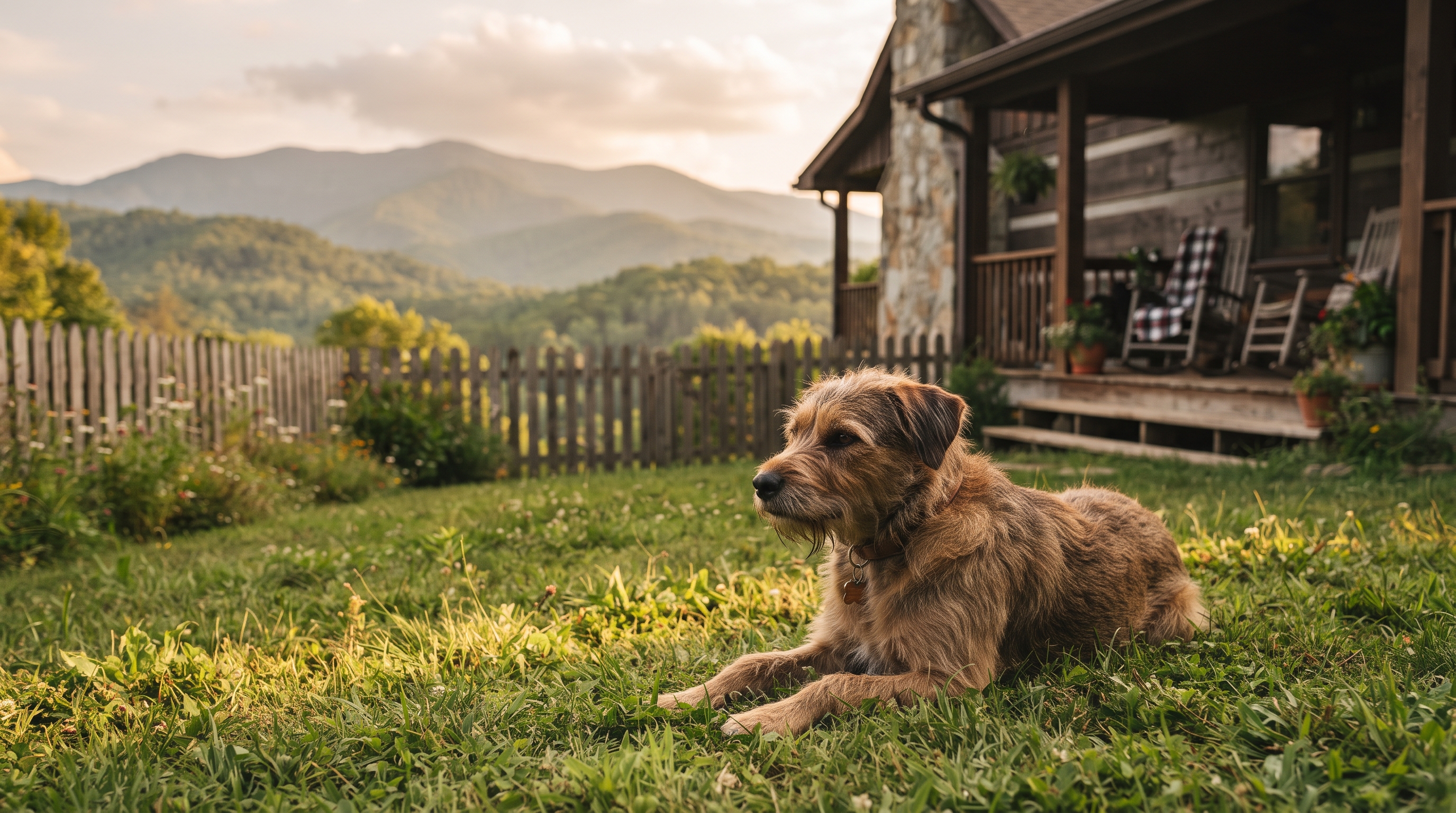
If your dog barks at strangers on the trail, panics at slamming car doors, or needs three days to settle into anywhere new, you’ve probably wondered whether a Smoky Mountain vacation is even worth the stress. You picture the crowded sidewalks of Gatlinburg, the packed parking lots at Cades Cove, and a dog who’s already on edge back home — and it’s tempting to just leave him with a sitter and go without him.
You don’t have to. Thousands of guests bring reactive, anxious, and shy dogs to the Smokies every year, and with the right prep and the right home base, it can be one of the calmest trips your dog has ever taken. The trick isn’t fixing your dog’s reactivity before you leave — it’s building a trip around it. That means choosing a cabin that gives your dog space to decompress instead of a hotel hallway full of triggers, and picking activities that play to your dog’s comfort zone instead of fighting against it.
Related: Understand the difference between reactivity and aggression.
This guide walks through exactly how to do that: what to do in the weeks before you leave, how to handle the drive itself, what to look for in pet-friendly lodging, and which Smoky Mountain activities actually work for a dog who doesn’t love surprises.
Why Your Home Base Matters More Than Your Itinerary
For a reactive or nervous dog, the single biggest variable in how a vacation goes isn’t the hiking trail or the restaurant patio — it’s where you’re staying. A hotel means elevators, hallway dog encounters, thin walls, and a leash-only existence from the moment you step out your door. For a dog who reacts to sudden movement or unfamiliar dogs at close range, that’s a five-day stretch of low-grade stress with almost no relief.
A cabin changes the entire equation. At Hapey’s properties — Blissful Tranquility, Timeless Tranquility, Sunny View Cabin, Sleepy Bear Ranch, and Hapey Memories — your dog gets a fully fenced area as part of our Pet Paradise Promise. That’s not a small thing for a reactive dog. It means your dog can be off-leash, sniffing around a private yard, without the risk of an off-leash encounter with someone else’s dog around a blind corner. No hallway ambushes. No shared elevator with a stranger’s leashed dog three feet away. Just a private outdoor space that’s entirely yours for the week, morning and night, whenever your dog needs to pace off some nervous energy or just lie in the grass and decompress.
There’s no pet fee standing between you and that space, either — our Pet Paradise Promise means zero pet fees at any of our six cabins, and our No-Surprise Pricing means the rate you see when you book is the rate you pay, with no last-minute “pet cleaning charge” sprung on you at checkout. Combined with our Clean-Cabin Guarantee, you can also skip one more source of anxiety: wondering whether the last dog who stayed there left behind smells or messes that might set your own dog off the moment you walk in.
Practically, that means your dog’s stress load on this trip comes almost entirely from travel and outings — not from the place you’re sleeping. That’s a huge advantage, and it’s worth choosing your cabin with reactivity in mind before you choose anything else about the trip.
Two to Three Weeks Before You Leave: Set Your Dog Up to Succeed
Reactive and anxious dogs do best when nothing on the trip is a total surprise. You can’t rehearse the whole vacation, but you can lower the number of “firsts” your dog has to process in a single week.
Practice short car rides first.
If your dog only rides in the car to the vet, a six-hour drive to the Smokies is going to be rough no matter how prepared you are otherwise. In the weeks before you leave, take a few short, low-stakes drives — to a park, a drive-through, anywhere pleasant — so the car itself isn’t a trigger by the time you load up for the real trip.
Talk to your vet about calming support.
If your dog has a history of significant travel anxiety or reactivity, this is the time to have that conversation — not the morning you leave. Vets can recommend anything from anxiety wraps and pheromone diffusers to prescription options for dogs who need more support, and most of these need a few weeks of lead time or a trial run at home to know what actually helps your dog.
Pack the familiar, not just the necessary.
Bring your dog’s actual bed, not a travel version. Bring the toy he already loves, not a new one you thought he’d like. A blanket that smells like home does more for a nervous dog in a new space than almost anything else you can pack. If you use a crate or a baby gate to help your dog settle at home, bring it — recreating that same “safe zone” in the cabin gives your dog an anchor point from the moment you arrive.
If a crate, extra gate, or other pet gear just isn’t practical to bring along — not every car has room for a crate on top of the family’s own luggage — Hapey partners with BabyQuip, so you can rent dog crates, gates, toys, and other pet supplies and have them waiting at the cabin when you arrive. One less thing to pack, and your dog still gets the safe zone he’s used to.
Confirm your route’s rest stops in advance.
Look for stops with some grass and a bit of distance from the main lot — truck stops and busy highway rest areas tend to be full of unfamiliar dogs at close range, which is exactly what you don’t want mid-drive with a reactive dog. A few minutes of route planning saves you from having to make that decision on the fly while your dog is already stressed.
The Drive: Making the Trip Itself Less of an Ordeal
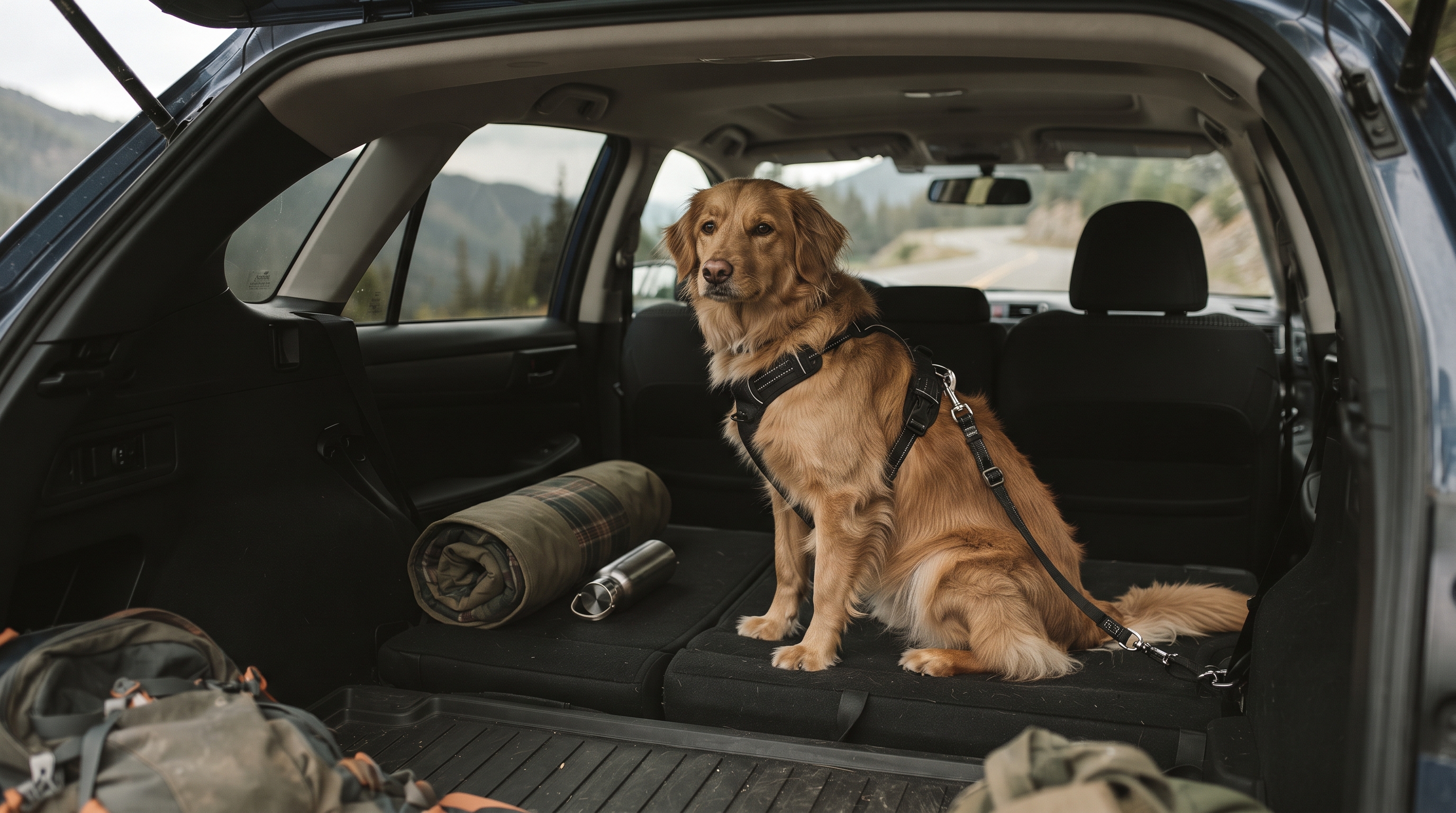
For a lot of dogs, the car ride is harder than the destination. A few things make a real difference:
Exercise before you load up.
A dog who’s had a walk or a good run in the 20–30 minutes before getting in the car settles faster and is less likely to spend the first hour whining or pacing in the back seat.
Secure your dog properly.
According to the AVMA’s guidance on securing pets in vehicles, a crash-tested harness that clips into the seatbelt, or a secured crate, does two things at once: it keeps your dog safe, and for a lot of anxious dogs, the physical containment itself is calming. A dog who can pace between windows and bark at every passing truck is a dog who’s rehearsing anxious behavior for six straight hours.
Stop before your dog asks you to.
Plan a break every two to three hours, not just when your dog seems desperate. Frequent, predictable stops keep stress from compounding, and they give you a chance to offer water and a bathroom break before your dog is already at the edge of his patience.
Let a bad moment pass before you keep driving.
If something spooks your dog at a rest stop — another dog, a slamming door, a loud truck — don’t just reload and pull back onto the highway. Give your dog a few calm minutes on a quiet patch of grass first. Rushing back on the road while your dog is still keyed up just adds that stress on top of the drive itself.
Time your arrival for daylight, if you can.
Arriving at a new cabin after dark, in an unfamiliar mountain driveway, with a dog who’s already tired and wound up from hours in the car, is a rough way to start a trip. If your schedule allows it, aim to pull in while there’s still light out — it makes the first exploration of the yard and cabin considerably calmer for a nervous dog.
Hapey makes this easier to plan around: standard check-in is during daylight hours, and early check-in is available on request when the cabin’s ready, so you’re not stuck timing a six-hour drive around a late-afternoon check-in window.
Choosing When to Go
If your dog struggles in crowds or with sudden noise, timing your trip matters almost as much as where you stay. Shoulder season — think early spring before the leaf-peeping rush, or late fall after the color has faded but before the winter holiday crowds — means quieter roads, shorter lines, and far less foot traffic downtown. A reactive dog navigating a nearly-empty stretch of the Gatlinburg Trail at 8 a.m. on a Tuesday has a completely different experience than the same dog on a July Saturday afternoon.
If you can only travel during a busier stretch, lean on early mornings. Trailheads, pet-friendly patios, and even downtown sidewalks are dramatically quieter before 9 a.m., which gives you a window to get your dog some fresh air and a change of scenery without the crowd density that triggers reactivity in the first place.
Know the Park Rules Before You Plan Around Them

It’s worth being upfront about this, because a lot of first-time visitors assume the national park is as dog-friendly as the surrounding towns — it isn’t, and that’s actually useful information for a reactive dog’s itinerary. Dogs are permitted on just two trails in the entire Great Smoky Mountains National Park: the Gatlinburg Trail (a flat, 1.9-mile path one-way from the Sugarlands Visitor Center to the edge of Gatlinburg) and the Oconaluftee River Trail on the North Carolina side. Dogs must stay on a leash no longer than six feet at all times, everywhere in the park, including campgrounds, picnic areas, and roadsides. Dogs are prohibited on every other trail in the park, and rangers do enforce it — the fine for an off-trail dog can run up to $5,000. Related: The park’s official pet policy.

For most families this rule is just a footnote. For a reactive dog, it’s actually a gift in disguise: it narrows your park-hiking decision down to one manageable, mostly flat option instead of an overwhelming list of backcountry trails with blind corners and unpredictable wildlife encounters. Walk the Gatlinburg Trail early in the morning, keep well clear of oncoming hikers and their dogs by stepping off to the side when you see them coming, and treat it as a short, controlled outing rather than a full-day hike. For a dog who’s easily overstimulated, that’s plenty. For the full run-down on what’s allowed and what isn’t, read “The Complete GSMNP Dog Policy” guide.
What to Actually Do Once You’re There
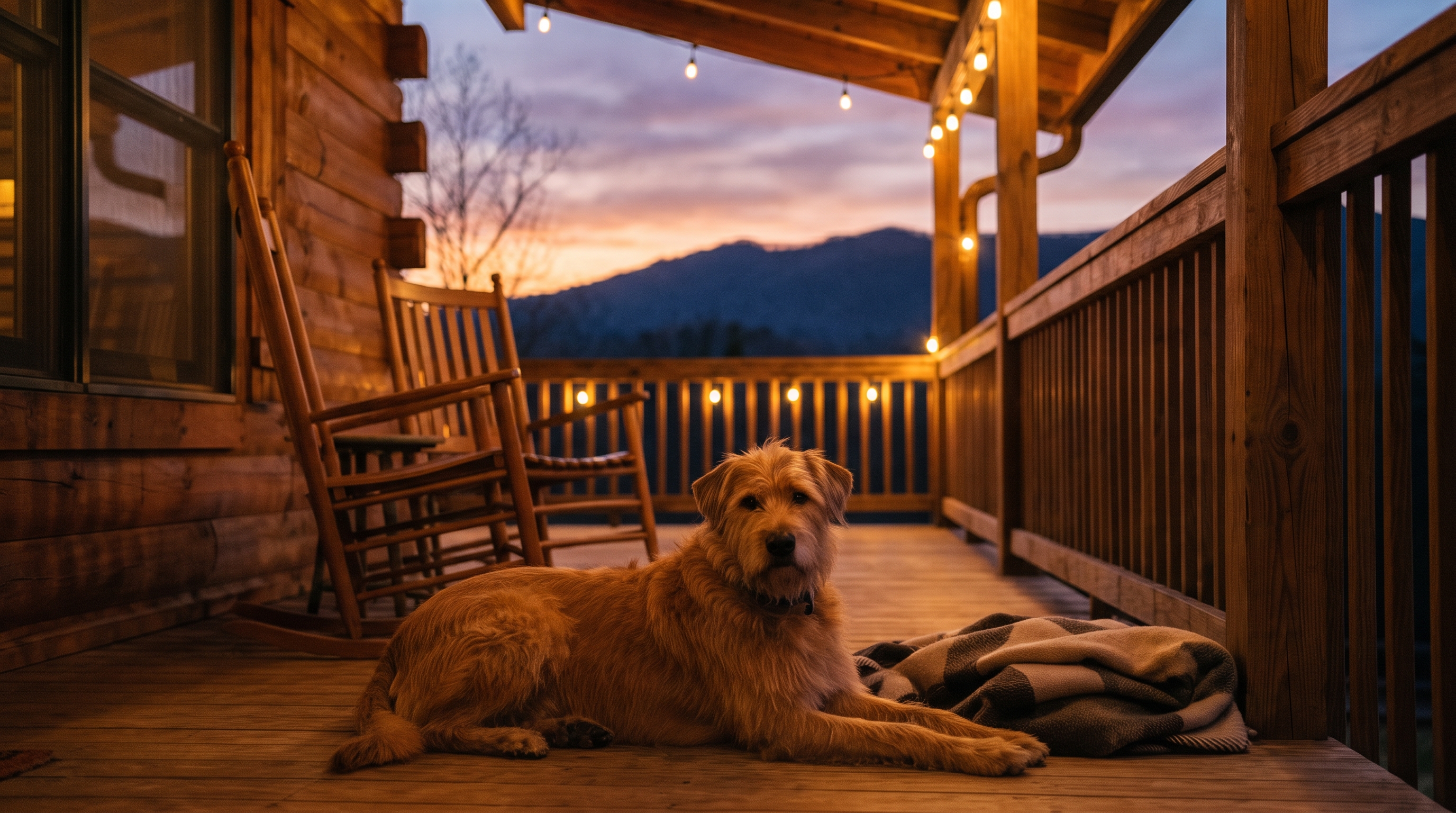
The goal for a reactive or nervous dog’s Smoky Mountain trip isn’t to pack in every attraction — it’s to build a schedule around low-stimulation wins.
Let the yard do most of the work.
Your fenced area at the cabin is your best tool all week. Rather than planning a leash walk through crowded downtown Gatlinburg or Pigeon Forge, let your dog burn energy and get fresh air off-leash, at his own pace, without the pressure of passing strangers or other dogs. A long game of fetch on the private lawn accomplishes more for a reactive dog’s nervous system than a stressful fifteen minutes on a packed sidewalk.
Pick dog-friendly patios during off-hours.
Plenty of restaurants and breweries between Pigeon Forge and Gatlinburg welcome dogs on their outdoor patios. Go at an off-peak time — a 4 p.m. early dinner instead of a Friday-night rush — and ask for a table on the edge of the patio rather than the middle, so your dog has a buffer zone instead of foot traffic on every side.
Choose driving over walking for sightseeing.
The Smokies have some genuinely stunning drives — Newfound Gap Road, the Cades Cove Loop, the Foothills Parkway — where your dog can take in mountain views from the back seat with the AC running and never have to interact with another dog or a stranger at all. For a dog who finds new environments overwhelming, a scenic drive can deliver the “we did something together” feeling of a day trip without any of the triggers.
Give your dog a full off-day.
Don’t schedule an outing every single day. A day where the biggest event is a long yard session, a nap on the porch, and an evening watching the sunset paint the ridgeline from the hot tub deck does more for a nervous dog’s overall trip experience than back-to-back excursions. Let your own evening on that sunset-soaked porch double as your dog’s recovery time.
Handling a Reactive Moment in Public
Even with the best planning, you may still run into a moment where your dog reacts — another dog appears around a bend on the Gatlinburg Trail, or someone reaches out to pet without asking. A few things help in the moment:
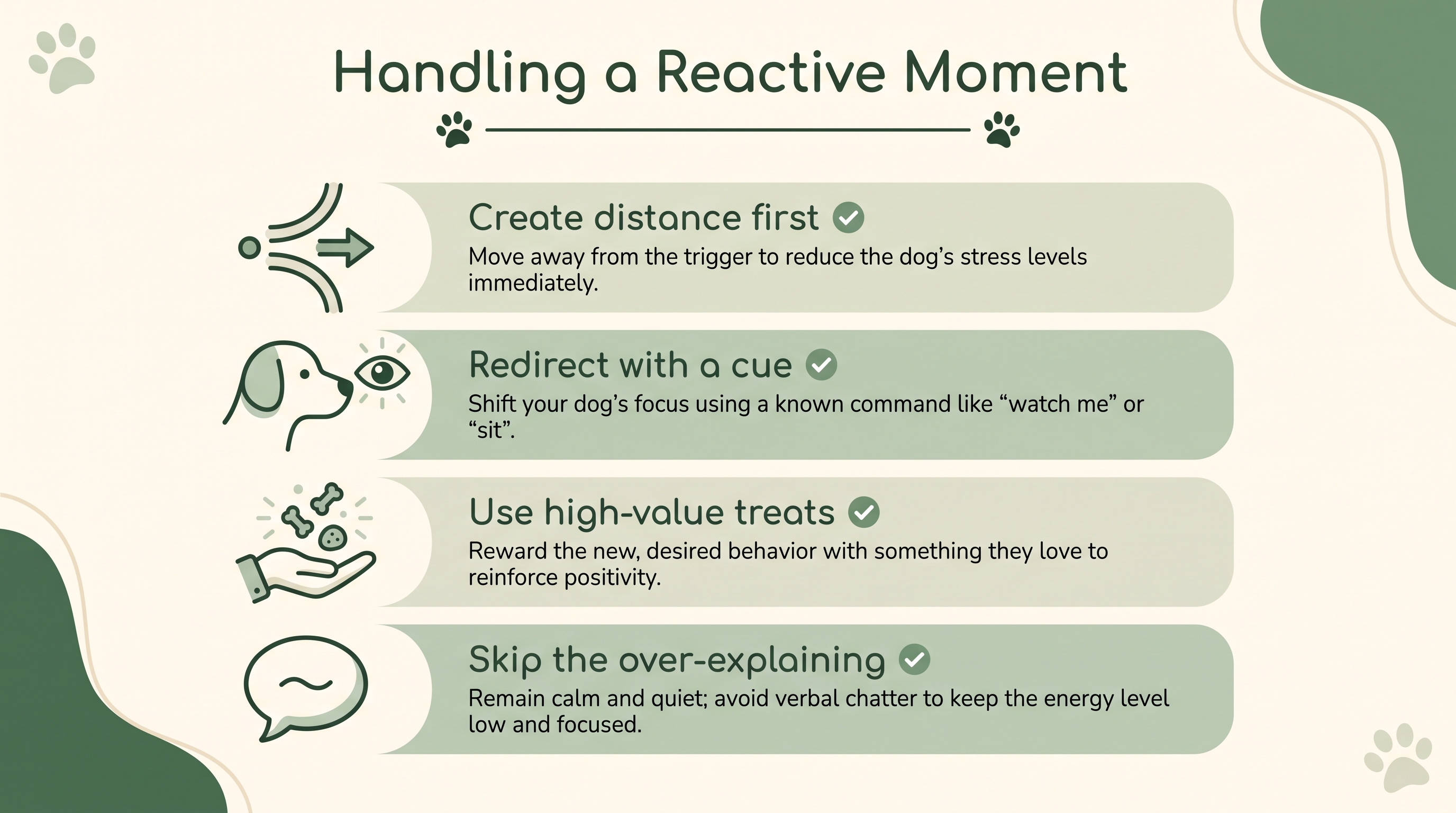
- Create distance first, correct second. Move your dog away from the trigger before you try to redirect his attention. You can’t out-cue a dog who’s still within reactive range.
- Use a trained “look at me” or “let’s go” cue to redirect focus back to you rather than trying to physically restrain your dog through the reaction.
- Carry high-value treats you only use for this purpose, so your dog has a strong, consistent reason to disengage and check in with you instead of fixating on the trigger.
- Don’t apologize your way through it. A quick “he’s still working on this, thanks for understanding” as you create space is enough. You don’t owe anyone a longer explanation, and rushing to over-explain often means you’re not fully focused on your dog in the moment that matters most.
Before You Go: A Few Safety Basics
Know the nearest emergency vet to your cabin before you need one — mountain roads take longer to navigate than GPS estimates suggest, especially at night. Keep your dog’s vaccination records and any calming medication with you rather than packed in checked luggage. And make sure your dog’s collar tag and any GPS tracker have your current cell number, since a reactive dog who does manage to slip a leash in an unfamiliar area is more likely to keep running rather than come when called.
Ready When You Are
A nervous or reactive dog doesn’t have to mean a Smoky Mountain vacation stays off the table — it just means building the trip around what actually helps your dog feel safe. That starts with a home base that gives your dog real decompression space instead of another source of stress.
Most of our Hapey cabins come with a fully fenced area, zero pet fees, and our Clean-Cabin Guarantee, so the only thing you have to manage all week is your dog’s comfort — not surprise charges or a sketchy yard fence. Browse our available cabins to find the layout that fits your family, and book direct for No-Surprise Pricing on your next Smoky Mountain trip — reactive dog and all.
2 thoughts on “Traveling to the Smokies with a Nervous or Reactive Dog”